Cart
0

How to Choose the Ideal Rug Size: A Complete Guide for Living Room, Bedroom, Dining Room & More
Choosing the perfect rug is about more than finding a beautiful design. Selecting the right rug size can completely transform how a room looks and feels.
A rug that is too small may make furniture appear disconnected and the room feel unfinished, while an oversized rug can overwhelm the space or interfere with natural movement.
At Saara Rugs, we believe the ideal rug should complement both your furniture arrangement and the proportions of your room. Whether you are selecting a rug for your living room, bedroom, dining area, hallway, or a completely custom interior, this guide will help you find the right size.
Why Is Choosing the Right Rug Size Important?
A rug visually connects the different elements of a room.
When properly sized, it can help define furniture groupings, create balance and make an interior feel more complete.
The right rug can make a room feel:
- More spacious
- More balanced
- Warmer and more inviting
- More luxurious
- Better coordinated
- Visually connected
Think of your rug as the foundation of the room. Furniture, lighting and accessories are arranged around it, making proportion especially important.
What Is the Ideal Rug Size for a Living Room?

The living room is one of the most important spaces when selecting a rug because the rug helps connect sofas, armchairs, coffee tables and other furniture.
One of the most common decorating mistakes is choosing a rug that is too small.
Small to Medium Living Rooms
Ideally, the rug should extend underneath at least the front legs of the sofa and surrounding chairs.
Popular rug sizes include:
- 160 × 230 cm — approximately 5.2 × 7.5 ft
- 200 × 250 cm — approximately 6.6 × 8.2 ft
- 200 × 300 cm — approximately 6.6 × 9.8 ft
- 250 × 300 cm — approximately 8.2 × 9.8 ft
- 250 × 350 cm — approximately 8.2 × 11.5 ft
For many standard living rooms, a 200 × 300 cm / 6.6 × 9.8 ft rug provides a balanced proportion.
Large Living Rooms
For spacious living rooms, villas and open-plan interiors, a larger rug can accommodate the entire furniture arrangement.
Popular larger sizes include:
- 250 × 350 cm — approximately 8.2 × 11.5 ft
- 300 × 400 cm — approximately 9.8 × 13.1 ft
- 300 × 450 cm — approximately 9.8 × 14.8 ft
- 350 × 450 cm — approximately 11.5 × 14.8 ft
- 400 × 500 cm — approximately 13.1 × 16.4 ft
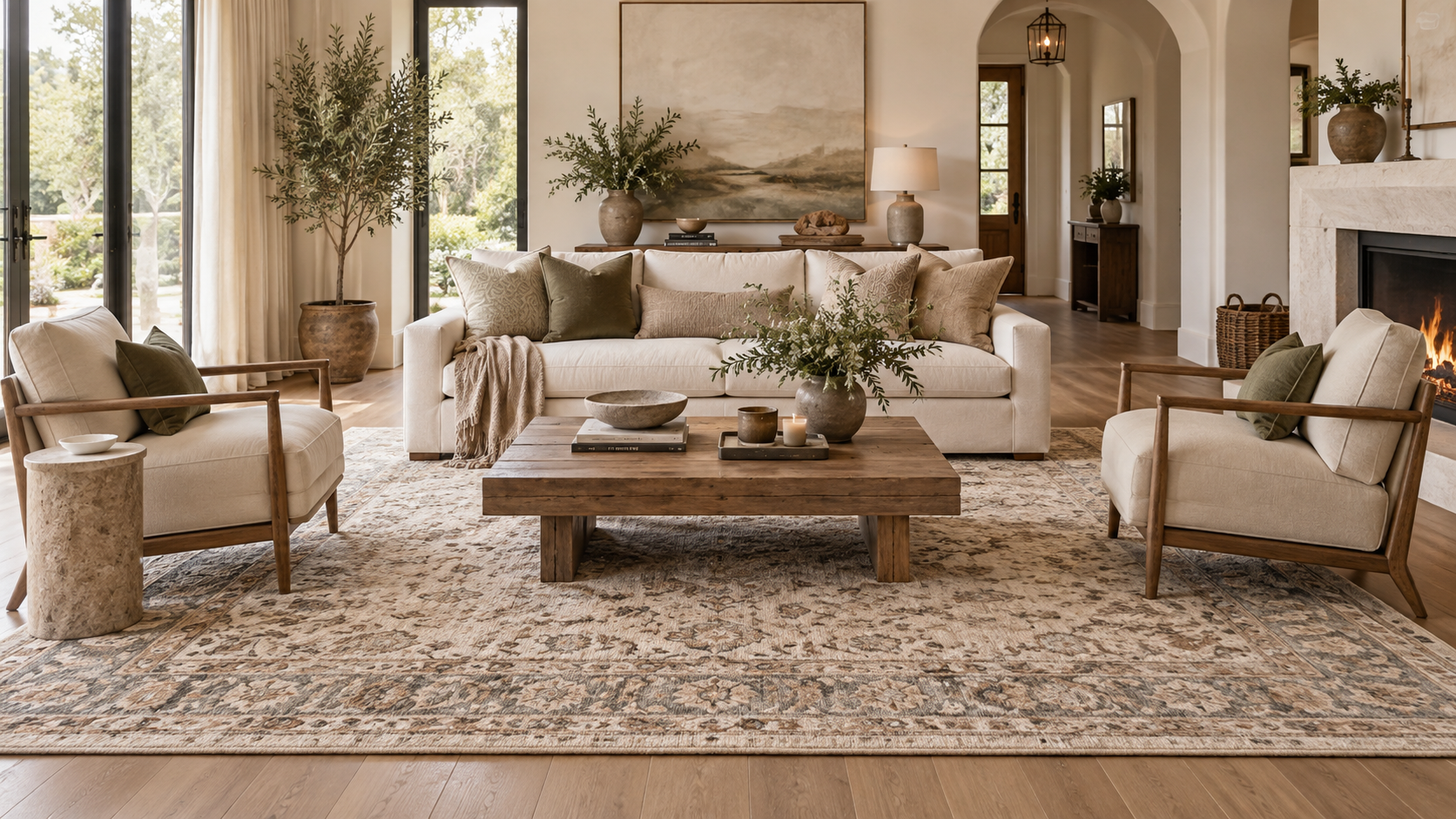
In larger interiors, placing the sofa, chairs and coffee table completely on the rug can create a beautifully unified seating area.
Living Room Rug Placement
There are three common approaches:
Front Legs on the Rug
The rug sits underneath the front legs of the sofa and chairs. This is one of the most versatile arrangements.
All Furniture on the Rug
Ideal for large rooms where the rug is spacious enough to accommodate the complete seating arrangement.
Floating Rug
A smaller rug sits primarily underneath the coffee table.
While this can work in compact interiors, the rug should still be large enough to visually connect with the surrounding furniture.
Common Living Room Rug Mistake
Avoid selecting a rug that only fits underneath the coffee table while leaving a large empty gap between the rug and sofa.
This can make the seating area feel disconnected and visually smaller.
What Is the Ideal Rug Size for a Bedroom?

Bedroom rugs should provide softness, comfort and warmth around the bed.
Ideally, the rug should extend beyond the sides and foot of the bed so that you step onto the rug when getting out of bed.
Rug Size for a Queen Bed
Recommended sizes include:
- 200 × 250 cm — approximately 6.6 × 8.2 ft
- 200 × 300 cm — approximately 6.6 × 9.8 ft
- 250 × 300 cm — approximately 8.2 × 9.8 ft
- 250 × 350 cm — approximately 8.2 × 11.5 ft
A larger rug creates a more luxurious look, particularly when it extends well beyond both sides of the bed.
Rug Size for a King Bed
Recommended sizes include:
- 250 × 300 cm — approximately 8.2 × 9.8 ft
- 250 × 350 cm — approximately 8.2 × 11.5 ft
- 300 × 400 cm — approximately 9.8 × 13.1 ft
For spacious master bedrooms, an oversized custom rug can create an elegant hotel-inspired appearance.
How Far Should a Rug Extend Beyond the Bed?
As a general guideline, allow approximately 50–70 cm / 1.6–2.3 ft of visible rug around the sides and foot of the bed.
This provides comfortable walking space while maintaining balanced proportions.
Alternative Bedroom Layout
Another option is positioning a rug underneath the lower two-thirds of the bed rather than underneath the entire bed and bedside tables.
This arrangement provides the luxurious appearance of a large rug while using slightly less floor coverage.
What Is the Ideal Rug Size for a Dining Table?

Choosing the correct dining room rug size is especially important because chairs are constantly being pulled in and out.
The rug should always be larger than the dining table.
As a general guideline, allow approximately 60–75 cm / 2–2.5 ft of additional rug space on every side of the table.
This allows dining chairs to remain comfortably on the rug even when pulled away from the table.
Dining Rug Example
If your dining table measures:
100 × 200 cm — approximately 3.3 × 6.6 ft
A suitable rug could measure approximately:
220 × 320 cm — approximately 7.2 × 10.5 ft
Depending on the room proportions, you may choose an even larger rug for a more luxurious appearance.
Rugs for Round Dining Tables
For a round dining table, a round rug can create a beautifully balanced composition.
For example:
- 120 cm / 3.9 ft round table → approximately 240–270 cm / 7.9–8.9 ft round rug
- 150 cm / 4.9 ft round table → approximately 270–300 cm / 8.9–9.8 ft round rug
Always ensure enough space remains for chairs to move comfortably.
What Rug Size Is Best for a Hallway?

Hallways generally work best with runner rugs.
The rug should follow the length and proportions of the hallway without completely covering the floor.
Popular runner sizes include:
- 70 × 200 cm — approximately 2.3 × 6.6 ft
- 80 × 250 cm — approximately 2.6 × 8.2 ft
- 80 × 300 cm — approximately 2.6 × 9.8 ft
- 90 × 300 cm — approximately 3 × 9.8 ft
- 90 × 400 cm — approximately 3 × 13.1 ft
For unusually long or wide hallways, a custom runner rug can provide a more precise fit.
Ideally, leave some visible flooring along each side of the runner to create a clean, balanced appearance.
What Is the Best Rug Size for an Entryway?

Entryway rugs should complement the proportions of the entrance while allowing doors to open comfortably.
Depending on the space, you can use:
- Rectangular rugs
- Round rugs
- Square rugs
- Runner rugs
- Organic-shaped rugs
Make sure the rug does not interfere with door clearance.
For spacious foyers, a statement round or irregular rug can create an impressive focal point.
What Rug Size Works Best Under a Coffee Table?

When using a rug underneath a coffee table, the coffee table should feel connected to the surrounding seating arrangement.
Rather than selecting a rug that matches only the size of the table, choose one that visually extends toward the sofa and chairs.
Popular options include:
- 160 × 230 cm — approximately 5.2 × 7.5 ft
- 200 × 300 cm — approximately 6.6 × 9.8 ft
- 250 × 300 cm — approximately 8.2 × 9.8 ft
- 250 × 350 cm — approximately 8.2 × 11.5 ft
- 300 × 400 cm — approximately 9.8 × 13.1 ft
Quick Rug Size Conversion Guide
| Size in Centimeters | Approximate Size in Feet |
|---|---|
| 160 × 230 cm | 5.2 × 7.5 ft |
| 200 × 250 cm | 6.6 × 8.2 ft |
| 200 × 300 cm | 6.6 × 9.8 ft |
| 220 × 320 cm | 7.2 × 10.5 ft |
| 250 × 300 cm | 8.2 × 9.8 ft |
| 250 × 350 cm | 8.2 × 11.5 ft |
| 300 × 400 cm | 9.8 × 13.1 ft |
| 300 × 450 cm | 9.8 × 14.8 ft |
| 350 × 450 cm | 11.5 × 14.8 ft |
| 400 × 500 cm | 13.1 × 16.4 ft |
Note: Foot measurements are approximate conversions. Since Saara Rugs offers custom sizing, your rug can be made according to exact dimensions in centimeters, feet, or inches.
How to Measure Your Room Before Buying a Rug
 Before ordering a rug, take accurate measurements of the room and furniture.
1. Measure the Room
Measure the complete width and length of the available floor area.
You can provide your measurements to Saara Rugs in centimeters, meters, feet, or inches.
2. Measure Your Furniture
Take measurements of sofas, beds, dining tables and chairs.
3. Decide Your Furniture Placement
Determine whether furniture will sit completely on the rug, partially on the rug or around it.
4. Consider Walkways and Doors
Make sure the rug does not block doors or create awkward circulation areas.
5. Mark the Rug Size on the Floor
Use masking tape or painter's tape to mark the proposed dimensions.
This simple step allows you to visualize how the rug will look before placing your order.
Should a Rug Touch the Walls?
In most rooms, rugs should not extend completely from wall to wall unless you are intentionally creating a wall-to-wall carpet installation.
Leaving visible flooring around the edges helps frame the rug and creates a more balanced look.
The ideal border will depend on the overall dimensions of the room.
Should the Rug Go Under the Entire Sofa?
Not necessarily.
For most living rooms, placing the front legs of the sofa and armchairs on the rug is enough to visually connect the furniture.
However, in large or luxurious interiors, placing the entire seating arrangement on the rug can create a more expansive and cohesive appearance.
What Shape of Rug Should You Choose?

The right rug shape depends on both your furniture and your interior design.
Rectangular Rugs
The most versatile choice for:
- Living rooms
- Bedrooms
- Dining rooms
- Offices
Round Rugs
Beautiful for:
- Round dining tables
- Reading corners
- Entryways
- Bedrooms
- Boutique interiors
Oval Rugs
A sophisticated alternative that works beautifully in both classic and contemporary spaces.
Runner Rugs
Ideal for:
- Hallways
- Kitchens
- Staircases
- Bedside areas
- Long narrow spaces
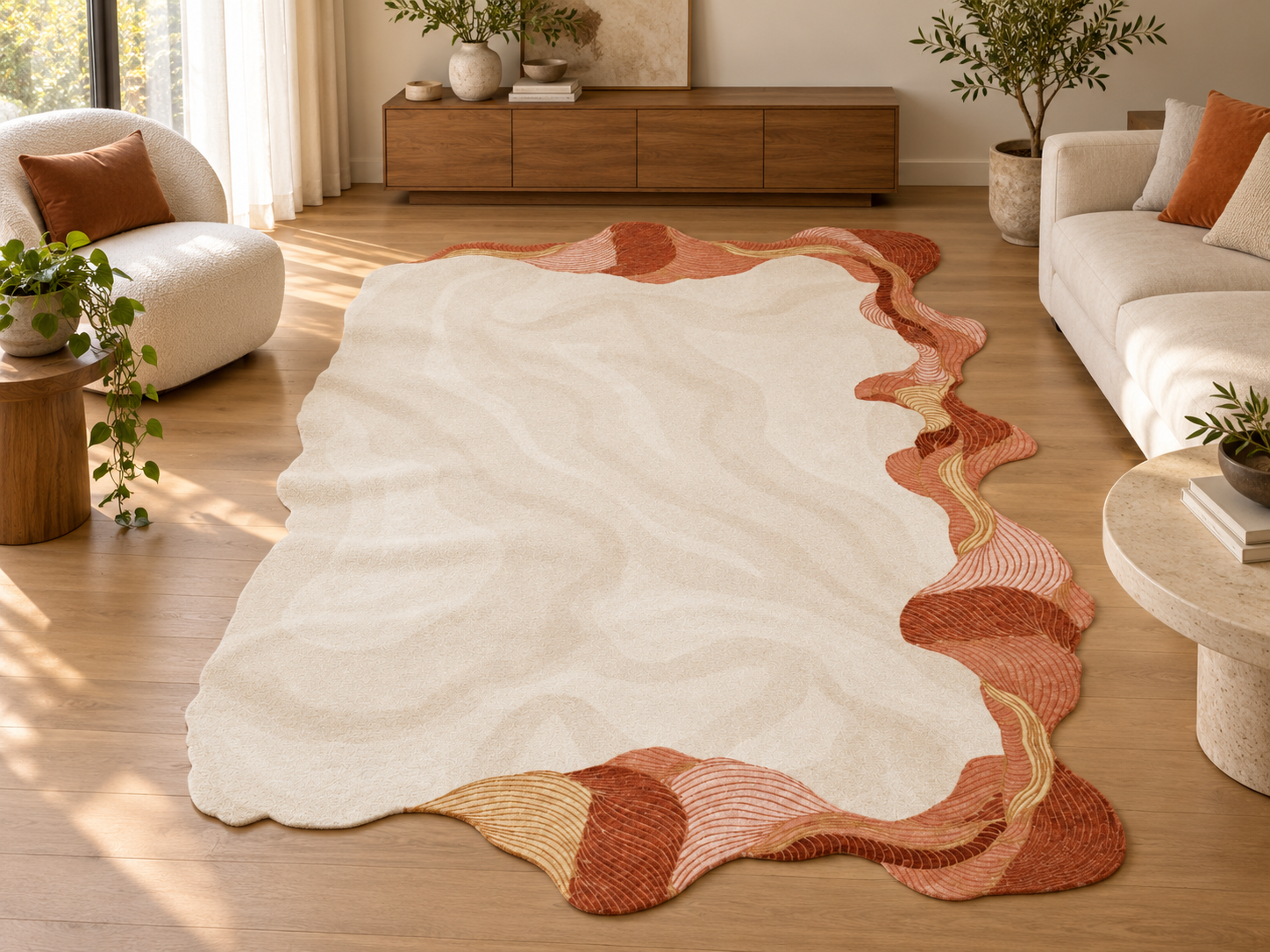
Organic and Irregular Rugs
Organic-shaped rugs add movement and individuality to modern interiors.
They work particularly well in:
- Contemporary living rooms
- Designer bedrooms
- Luxury lounges
- Creative offices
- Boutique hospitality interiors
At Saara Rugs, custom shapes can also be developed according to your interior layout.
Standard Rug or Custom-Made Rug: Which Is Better?

Standard rug sizes work beautifully for many interiors.
However, every room is different.
Furniture layouts, architectural proportions and personal design preferences may require a rug that cannot be achieved with conventional sizing.
A custom-made rug can be particularly useful when:
- Your room has unusual dimensions
- You need an oversized rug
- You require an exact dining table proportion
- You want an organic or irregular shape
- You are furnishing a villa or large majlis
- You need a custom runner
- Your furniture has been made to measure
- You want specific colors or patterns
- You are working on a designer or architectural project
Custom sizing allows the rug to become part of the overall interior design rather than simply being added after the room is finished.
Custom Rug Sizes at Saara Rugs
At Saara Rugs, we create handcrafted rugs in custom sizes, shapes, colors and designs.
Whether your measurements are in centimeters, meters, feet, or inches, our team can develop the rug according to the exact requirements of your space.
Our collection includes:
- Living room rugs
- Bedroom rugs
- Dining room rugs
- Large and oversized rugs
- Round rugs
- Oval rugs
- Organic and irregular rugs
- Custom runners
- Stair runners
- Wall-to-wall rugs
- Handmade wool rugs
- Hand-tufted rugs
- Hand-knotted rugs
- Handwoven rugs
- Custom-designed rugs
You can also customize selected designs according to the dimensions and color palette of your project.
Frequently Asked Questions About Rug Sizes
What is the most popular living room rug size?
A 200 × 300 cm / approximately 6.6 × 9.8 ft rug is a popular option for medium-sized living rooms.
Larger spaces often require:
- 250 × 350 cm / 8.2 × 11.5 ft
- 300 × 400 cm / 9.8 × 13.1 ft
- Or completely custom dimensions
Should the sofa sit on the rug?
Ideally, at least the front legs of the sofa should sit on the rug. In larger rooms, the entire sofa and seating arrangement can be positioned on the rug.
How much larger should a dining rug be than the table?
Allow approximately 60–75 cm / 2–2.5 ft of additional rug space on every side so chairs remain on the rug when pulled away from the table.
How much rug should show around a bed?
Approximately 50–70 cm / 1.6–2.3 ft of rug visible around the sides and foot of the bed generally provides comfortable proportions.
Can I order a rug in a custom size?
Yes. Saara Rugs offers custom sizing in centimeters, feet and inches for projects requiring specific dimensions, including oversized rugs, runners and irregular shapes.
Are irregular rugs suitable for living rooms?
Yes. Organic and irregular rugs work beautifully as statement pieces in contemporary living rooms and can help soften spaces dominated by straight architectural lines.
Should a rug be larger than the furniture?
The rug does not necessarily need to extend beyond every piece of furniture, but it should be large enough to visually connect the main furniture arrangement.
Find the Perfect Rug Size with Saara Rugs
The right rug size can transform the proportions, comfort and overall appearance of your room.
Before purchasing, consider your furniture layout, available floor space, walkways and how you would like the rug to interact with the rest of the interior.
If standard dimensions do not perfectly suit your space, Saara Rugs can create a custom rug designed specifically for your room.
Simply share your measurements in centimeters, meters, feet, or inches, and our team can help create the ideal size for your interior.
From elegant living room rugs and bedroom rugs to oversized statement pieces, runners and unique organic shapes, our handcrafted rugs combine thoughtful design with skilled craftsmanship.
Explore our rug collection or contact Saara Rugs to discuss a custom size, shape or design for your interior.
Website: www.saararugs.com
Email: info@saararugs.com